
“Oh, I’m getting old.”
“I’m useless now.”
“This is just dementia. There’s no cure for it.”
As the global population continues to age, the incidence of neurodegenerative diseases has increased significantly. Among them, the two most common are Alzheimer’s disease (AD) and Parkinson’s disease (PD). Although these conditions differ in their symptoms and underlying pathologies, they also share many similarities. Understanding both their commonalities and distinctions is crucial for early detection, accurate diagnosis, and effective intervention.
I. Similarities
1. Most commonly affects the elderly

Both AD and PD show an increasing prevalence with advancing age. They are among the most common chronic conditions in older adults, and aging is the most significant risk factor for both diseases.
2. Neurodegenerative in nature
AD and PD are both classified as neurodegenerative diseases, meaning they involve progressive damage and loss of function in nerve cells over time. This process is irreversible, and symptoms gradually worsen. Because the brain damage cannot be reversed, these conditions are often viewed as incurable. However, while we cannot regenerate the lost neurons, we can alleviate symptoms and improve quality of life. Since symptoms tend to progress over years, long-term management and care from family members are essential.
3. Potential to impair cognitive function

AD is primarily characterized by cognitive decline, while PD begins with motor symptoms. However, in the later stages of PD, memory loss and other cognitive impairments often emerge, and some patients develop Parkinson’s disease dementia.
4. Abnormal protein accumulation

Both conditions involve the accumulation of abnormal proteins in the brain. In AD, beta-amyloid plaques and tau tangles are commonly found. In PD, the characteristic pathology is the buildup of alpha-synuclein into structures known as Lewy bodies.
5. Symptomatic treatment

There is currently no cure for either Alzheimer’s or Parkinson’s. Treatment strategies focus on symptom management, slowing disease progression, and enhancing quality of life for patients.
II. Differences
1. Affected brain regions
Alzheimer’s disease mainly affects the cerebral cortex and hippocampus, areas responsible for memory and cognition.Parkinson’s disease primarily affects the substantia nigra in the midbrain, which is involved in controlling movement.
2. Symptoms
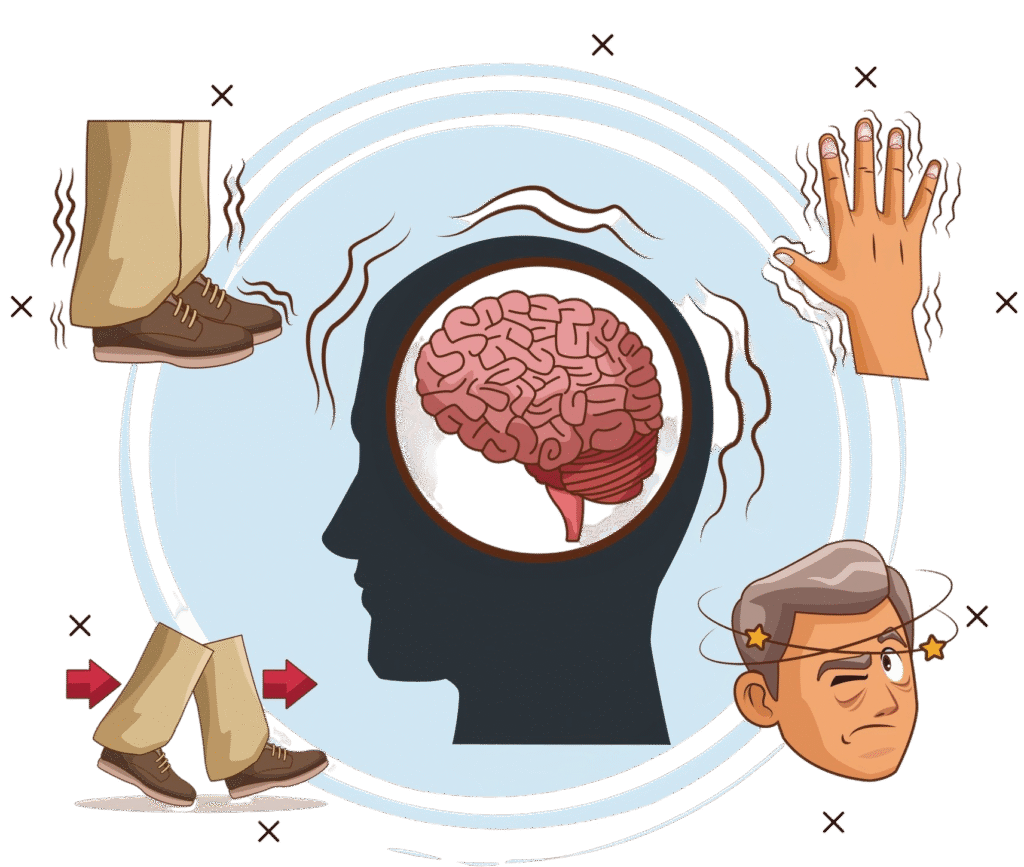
Though both diseases originate in the brain, they affect different regions, leading to distinct symptom profiles. The affected regions for Alzheimer’s Disease is control memory and cognitive functions, so early symptoms typically involve declining memory, especially short term memory. As the disease progresses, more typical symptoms include memory loss, language difficulties, disorientation, and emotional changes. For Parkinson’s Disease (PD), the region affecting is controlling the impacts of movement control.Thus, the early symptoms are mostly motor-related, such as tremors, slowness of movement (bradykinesia), and muscle stiffness. In later stages, typical symptoms include resting tremor, abnormal gait, rigidity, and postural instability.Tremors are uncommon in AD. Some patients may develop both AD and PD simultaneously, which complicates diagnosis and treatment.

3. Pathological mechanisms
Although both are neurodegenerative disorders, their underlying disease mechanisms are completely different: For AD is mainly caused by the abnormal accumulation of beta-amyloid and tau proteins. PD is driven by the deposition of alpha-synuclein, forming Lewy bodies.
III. Traditional Chinese Medicine (TCM) Perspective

From a TCM perspective, Alzheimer’s and Parkinson’s are considered two distinct conditions with different pathophysiological foundations:
1. Alzheimer’s Disease
Often attributed to deficiency syndromes, such as insufficiency of the heart, liver, spleen, and kidneys, sometimes complicated by the presence of phlegm and blood stasis.

2. Parkinson’s Disease
Considered a result of internal wind, often due to blood deficiency or hyperactivity of liver wind.
In treating these diseases, TCM adopts a holistic approach based on syndrome differentiation, using a combination of herbal medicine, acupuncture, and comprehensive body regulation to alleviate symptoms and delay disease progression. While a complete cure remains elusive, TCM plays an increasingly significant role as a complementary therapy.

Alzheimer’s disease and Parkinson’s disease are two chronic neurological conditions that demand growing attention among the elderly.
They differ in causes, symptoms, and treatment approaches, but also share important features. Enhancing public awareness of these diseases is key to early recognition and timely intervention, ultimately reducing the burden on patients and their families. With ongoing advancements in medical research, we may one day discover more effective treatments and give patients renewed hope.
此文章还有以下语言版本:
 简体中文 (Chinese (Simplified))
  Melayu (Malay)
