
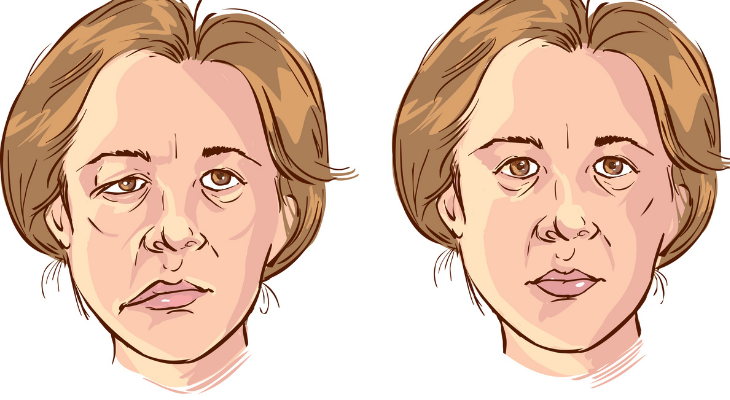
What is bell’s palsy?
Bell palsy also known as facial nerve paralysis, a common neurological disease.
Mainly refers to facial muscle paralysis, a disease caused by facial nerve damage due to various reasons.
Mainly manifested as impaired facial expression muscle motor function, such as crooked mouth, inability to raise eyebrows when making expressions, no forehead wrinkles, incomplete eyelid closure, loss of nasolabial fold on the affected side, mouth tilted to the healthy side, inability to inflate, leakage when drinking water.
Mostly due to the facial nerve being stimulated by wind and cold, virus invasion or excessive fatigue.
What are the signs of bell’s palsy?
Many people wonder how bell’s palsy can happen without any warning signs. In fact, maybe it has warning signs, but we have ignored it.
Sign 1: Ear discomfort
This is because the facial nerves are invaded by viruses, just like the invasion of wind, cold or heat in traditional Chinese medicine. The nerves are tense and pull the muscles of ear, causing discomfort in the ears. In severe cases, it can also cause ear pain. However, a lot of people will tend to ignore them because most of the time the symptoms are still mild. They never thought that it is the main precursor to bell’s palsy!
Sign 2: Involuntary tremors in the eyelids
Sometime, when one eyelid trembles slightly, we think it is just a simple eyelid twitching, and we will even joke about it. However, you may not know that your joke may be a sign of your hidden disease! Especially when you forcefully close your eyes, you may feel a slight muscle contraction tremor on one side of the upper eyelid, but not on the other side. At this moment, you should pay attention to whether you will tend to have bell’s palsy.
Sign 3: Depression or prolonged overwork
Many people will have a period of depression before bell’s palsy and coupled with irregular lifestyle, long hours of staying up late and other bad habits, which lead to immunity of body decrease. This is what traditional Chinese medicine said “deficiency of vital energy”. Once the wind enters the body, the probability to get bell’s palsy in the next day is very high.
You can check whether you have bell’s palsy by following the 6 steps below:
1. Lift your forehead: To see if the forehead wrinkles are symmetrical or one side cannot be lifted.
2. Frown your brows: To see if you can frown comfortably.
3. Close your eyes: To see if you can close them completely or one side cannot close them easily.
4. Puff your cheeks: To see if there is any air leakage.
5. Compare your nose, mouth grooves and eyes: To see if they are symmetrical.
6. Try to whistle: To see you can whistle.
When people hear about facial paralysis, their first reaction is: Did I have a stroke?
Stay calm! Although stroke may also cause facial paralysis, but there is a difference between both.
Bell’s palsy: The facial nerve is affected, and the problem is mainly on the face, and other parts are generally fine.
Stroke: Nerves of the brain are affected, and the problem not only on the face may also with the problem in limbs, language, and consciousness.
Nevertheless, stroke may also cause facial paralysis, because there are many causes lead to bell’s palsy.
You can also click here to check out the other article titled “Facial Paralysis ≠ Stroke” to know more.
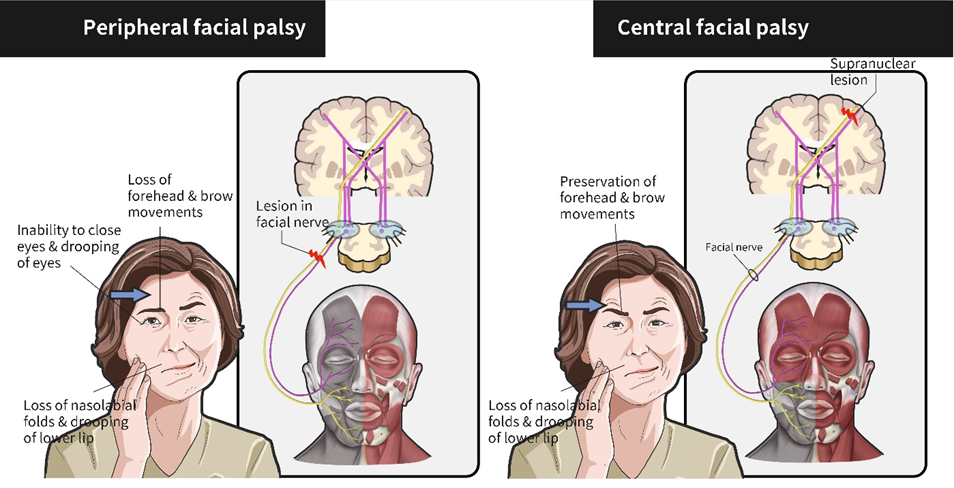
Facial paralysis can be divided into:
Facial paralysis also divided into two, because although they are all “drooped mouths”, there are still differences in symptoms.
1. Peripheral facial paralysis
- 70% of facial paralysis cases are peripheral facial paralysis
- Mainly complete paralysis of one side of the face
- The onset is rapid, usually occur within few hours or days
- Main causes:
- The most common cause is idiopathic facial nerve paralysis. It is called as an idiopathic because the cause is unknown. It may be related to multiple factors such as viral infection (such as herpes virus), autoimmune reaction (tired, cold), and vascular ischemia.
- Facial trauma is the second largest cause: such as fractures and cuts, which may directly damage the facial nerves.
2. Central facial palsy
- Main symptoms are paralysis of the lower face, possibly accompanied by hand and foot dysfunction
- Main causes: Usually caused by brain lesions (such as stroke, tumor), resulting in damage to the cerebral cortex or cortical brainstem. The most common are cerebral infarction, cerebral hemorrhage, brain tumor, encephalitis or brain trauma, which require immediate head CT/MRI examination.
Differences between peripheral facial palsy and central facial palsy:
| Peripheral Facial Paralysis | Central facial palsy | |
| Forehead wrinkles | One side of the forehead wrinkles will become lighter or disappear, and you can’t raise your eyebrows | The forehead wrinkles on both sides are symmetrical, without becoming lighter or disappear and both can lift the eyebrows |
| Eye | The eye does not close completely, or it closes but is significantly weaker than the unaffected side | Both eyes can close completely |
| Others | No physical impairment, speech impairment, and mental disorder | Symptoms include limb weakness, speech impairment, and mental disorder |
| Characteristic | Peripheral facial palsy | Central facial palsy |
| Condition | Serious | Mild |
| Symptoms | Paralysis of the facial muscles resulting in loss of facial expression | Affects the lower part of the face on the opposite side of the brain lesion (loss of nasolabial fold, drooping mouth) |
| Recovery speed | Slow | Fast |
| Common causes | Inflammation and swelling of the facial nerve | Cerebrovascular disease and brain tumours |
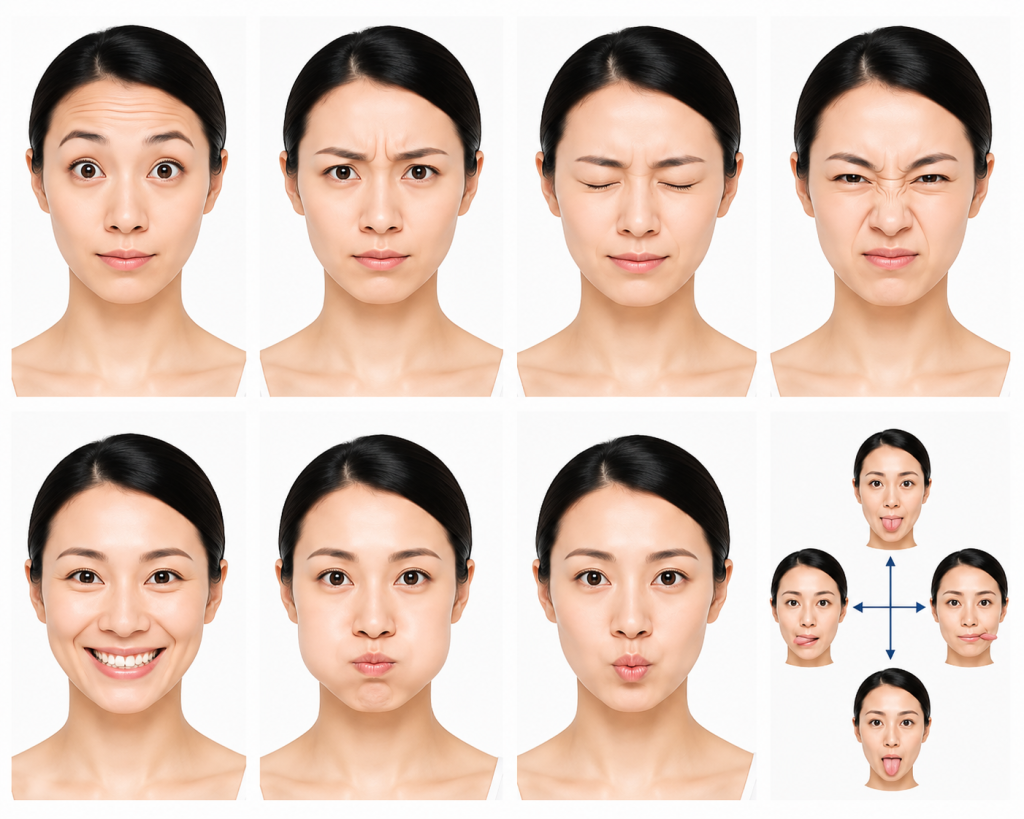
Rehabilitation training for bell’s palsy:
Raise your eyebrows, close your eyes, wrinkles your nose, show your teeth, and puff out your cheeks in front of the mirror. Repeat and practice each movement many times every day. This can strengthen your facial muscles, improve the nerves’ ability to control the muscles, and promote the recovery process.
- Movement 1: Raise eyebrows (hold for 5 seconds, and then slowly relax)
- Movement 2: Frown eyebrows (hold for 5 seconds, and then slowly relax)
- Movement 3: Close your eyes (hold for 5 seconds, and then slowly relax)
- Movement 4: Wrinkle your nose (hold for 5 seconds, and then slowly relax)
- Movement 5: Show your teeth (hold for 5 seconds, and then slowly relax)
- Movement 6: Puff up your cheeks (hold for 5 seconds, and then slowly relax)
- Movement 7: Purse your lips (hold for 5 seconds, and then slowly relax)
- Movement 8: Tongue movement (move your tongue up, down, left and right, hold for 5 seconds each, and then slowly relax)
此文章还有以下语言版本:
 简体中文 (Chinese (Simplified))
  Melayu (Malay)
